Latest Insights & Industry Guides
Insights • Strategy • Technology • Franchise • Sustainability
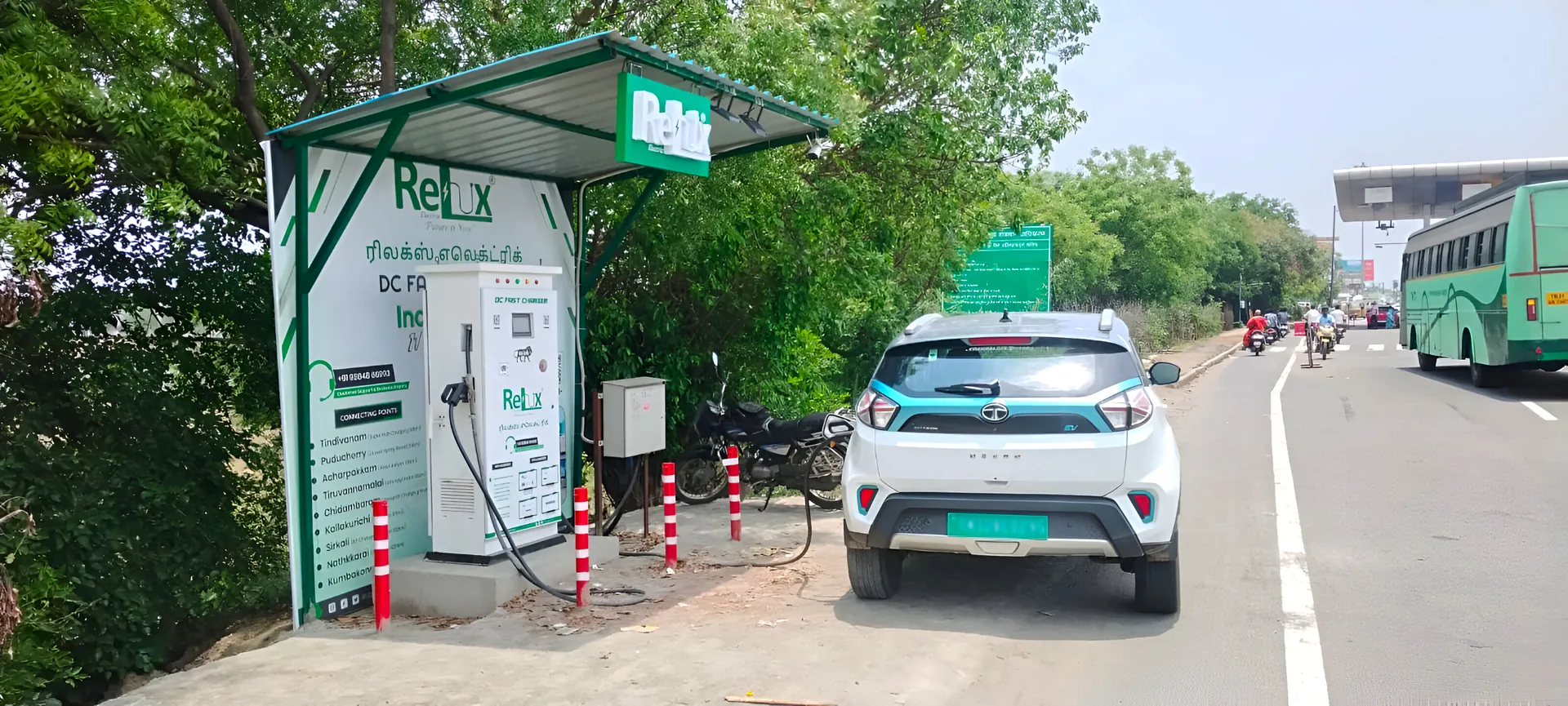
Why Chennai's New EV Charging Station Matters for Every EV Driver
Another public charging point went live at Besant Nagar. On its own, that's not news Chennai has been adding charge points steadily since the Tamil Nadu EV Policy 2019 set the tone for state backed EV infrastructure. What's worth a closer look isn't the announcement. It's the site logic behind it. The station is a joint deployment between the Greater Chennai Corporation (GCC), the Tamil Nadu Green Energy Corporation (TNGEC), and Relux Electric as the Charge Point Operator (CPO) the entity that installs, runs, and maintains the charger. The government provides land and mandate. The private operator handles execution and day to day operations. This model is now the dominant approach for public charging in Tamil Nadu.
Topics Covered In This Blog
Project Highlights
- Location: Besant Nagar, Chennai
- Charge Point Operator (CPO): Relux Electric
- Charging Standard: CCS2 DC fast charging
- Public Partners: Greater Chennai Corporation (GCC), Tamil Nadu Green Energy Corporation (TNGEC)
- Operator Track Record: Relux Electric active in EV charging infrastructure since 2012, MoP guideline compliant
- Policy Alignment: Tamil Nadu EV Policy 2019 / Public EV Charging Infrastructure guidelines
- Objective: Expanding last mile public charging density in a high catchment residential-commercial zone
Choosing the Right Location
The default approach to charge point siting has been availability driven install wherever land and power sanction come together easily. That produces a scattered network with unpredictable usage. The better approach is catchment-driven: map commuter flow and existing charging gaps before finalizing a site.
Besant Nagar sits inside a corridor with steady daily movement toward ECR and Adyar, plus a residential base where apartment living limits home charging a constraint that's easy to overlook when most EV planning assumes standalone house charging as the default.
Why it matters: A charge point's utilization rate how often it's actually used, not its rated power on a spec sheet determines whether the operator recovers its investment within a reasonable timeframe. Site selection is the single highest leverage decision in the entire deployment.
How it benefits:
- Higher session frequency, since the location sits inside an existing commute pattern instead of requiring a special trip.
- Real demand from apartment residents who lack home charging and depend on public infrastructure.
- A strong enough usage baseline to justify adding a second or third bay at this site later.
Smooth Traffic Flow In and Out
A charge point that causes vehicles to queue onto the road isn't a minor inconvenience it's a traffic engineering failure that invites municipal pushback.
Why it matters: GCC weighs future site approvals partly on how well existing ones performed. A site that generates traffic complaints makes the next approval harder for this operator and for the sector.
How it benefits:
- Clean entry and exit geometry keeps the adjoining road unaffected during peak hours.
- Predictable circulation lowers collision risk inside the charging bay itself.
- A traffic-neutral design becomes a reference point GCC can point to when approving similar sites elsewhere.
Dedicated Parking for EV Charging
ICE ing non EVs occupying EV bays is one of the most persistent problems at Indian charging sites, particularly where bays aren't clearly marked off from general parking.
Why it matters: A charger's uptime figure means nothing if the bay itself isn't accessible. Bay occupancy is an availability problem the charger's own metrics won't capture.
How it benefits:
- Clearly signed, demarcated bays cut down ICE ing incidents and the resulting frustration.
- Fleet operators can factor this site into route planning with confidence, rather than treating it as a fallback.
- A cleaner throughput number for the operator actual sessions per bay per day, without blocked-bay downtime skewing it.
Why Nearby Businesses Benefit
A CCS2 DC fast charge typically runs 30 minutes to an hour depending on battery size and state of charge on arrival. That's a fixed block of captive customer time for any café or retail outlet within walking distance the same value fuel retailers have monetized for decades through forecourt stores.
Why it matters: Property owners and lessors who haven't priced EV charger proximity into their tenant mix are leaving value on the table.
How it benefits:
- A recurring, time-bound customer segment for cafés and quick-service retail near the station.
- Retail formats can be planned around the typical session length quick service, app-based ordering.
- A quantifiable footfall driver that property owners can factor into rent negotiations for nearby leases.
Safety and Security
A meaningful share of demand night shift commuters, late return residents, women driving alone won't use a station perceived as unsafe, regardless of how reliable the charger itself is.
Why it matters: Safety perception gates the station's effective operating hours. A technically 24×7 station that's avoided after 9 PM isn't really a 24×7 asset in practice.
How it benefits:
- Adequate lighting and CCTV coverage extend the hours people actually use, not just the hours the station is technically open.
- Visible security reduces hesitation for solo and first-time charging users.
- Lower incident risk means lower operational liability for the CPO over time.
Reliable Charging, Less Downtime
Ask any fleet operator what matters most in a public charger, and uptime consistently beats charging speed. A 60kW charger down 15% of the time is a worse asset than a 30kW charger running at 98% uptime.
Why it matters: Downtime doesn't just cost one missed session it erodes trust in public charging as a category, and that trust is expensive to rebuild.
How it benefits:
- Higher uptime directly improves revenue per bay per day, the core unit economics metric for any charging network.
- Predictable availability reduces fleet operators' reliance on their own captive charging setups.
- Remote diagnostics under OCPP (Open Charge Point Protocol, the standard link between chargers and the operator's monitoring system) catch faults before a user arrives to a dead charger.
24×7 Availability
Private EV owners mostly charge on a predictable schedule. Commercial EVs delivery fleets, ride hailing, last mile logistics don't. Their duty cycles run across shifts, and restricted hours simply exclude this segment.
Why it matters: Fleet and commercial electrification is where much of India's near-term EV volume growth is expected to come from. Infrastructure that ignores shift-based duty cycles is planning around the wrong growth curve.
How it benefits:
- Round the clock access removes the scheduling constraint that pushes fleets toward private depots instead of public charging.
- Private owners get access on par with conventional fuel retail closing a parity gap that has slowed EV consideration.
- Makes the station genuinely useful to shift based users, a segment public charging has largely underserved.
The Right Charging Standard: CCS2
The station runs CCS2 (Combined Charging System Type 2) the connector standard aligned with Ministry of Power guidelines and the one most OEMs selling DC fast charge capable EVs in India have standardized around.
Why it matters: Connector fragmentation is a real problem in emerging EV markets. A station built on a proprietary or minority connector has a hard ceiling on how many vehicles it can serve, and a real risk of costly retrofits later.
How it benefits:
- Broad compatibility with the current and near future population of DC fast charge capable EVs on Indian roads.
- Direct alignment with MoP guidelines, relevant for continued eligibility in public-private programmes.
- Faster charge cycles than AC Type 2 charging, which improves bay turnover at a site where commuters and residents compete for the same bays.
Supporting a Greener Chennai
A single charge point's direct emissions offset is small against citywide numbers. Judged that way alone, it misses the point the real mechanism isn't the electrons delivered at one site, it's the confidence a reliable network builds among buyers still on the fence.
Why it matters: Infrastructure confidence is a leading indicator of EV purchase intent, not a lagging one. Buyers weigh charging network density before they buy, not after.
How it benefits:
- Removes a concrete hesitation point for prospective EV buyers in the surrounding residential catchment.
- Adds, incrementally but measurably, to Chennai's air quality and emissions goals in a dense mixed-use zone.
- Supports Tamil Nadu's stated clean energy and green mobility targets under its EV policy framework.
A Model Built for Public-Private Collaboration
Final Thoughts
Your EV Charging Business Deserves a Partner Who Shows Up Every Single Day
At Relux Electric, we build reliable, high-uptime charging hubs with turnkey execution, smart CMS software, and full operational support across India.
Start Your Franchise Today