Latest Insights & Industry Guides
Insights • Strategy • Technology • Franchise • Sustainability
Why Highway EV Charging Hubs Are Booming Across India in 2026
India's highway network is witnessing a significant shift towards electric mobility. Electric vehicles are moving beyond city streets, finding their place on intercity routes, expressways and long-distance travel corridors. As this shift gathers momentum, one important development is changing the way people think about electric mobility, the rise of Highway EV Charging Hubs.
For years, one of the biggest concerns surrounding electric vehicles was Charging Accessibility Concerns. Drivers were willing to consider ecofriendly alternatives, but the uncertainty of finding a reliable charging point during a long journey remained a significant barrier. Today, that scenario is changing. Dedicated charging locations, faster charging technology, government initiatives and private-sector investments are gradually creating a more accessible ecosystem.
The transformation is not simply about installing more charging plugs. It is about developing dependable highway networks that allow drivers to travel farther, plan better and spend less time worrying about their next charge. So, what is driving this growth in 2026, and why are EV Charging Hubs on Highways becoming an important part of India's transportation landscape?
Let's explore.
Topics Covered In This Blog
India's EV Revolution Is Moving Beyond City Limits?
Electric mobility in India is no longer restricted to urban commuting. As vehicle options expand and consumer awareness improves, electric cars are increasingly being considered for longer journeys.
According to the International Energy Agency's (IEA) Global EV Outlook 2026, India's public charging network reached approximately 88,000 charging points by the end of 2025, representing a 15% increase over the previous year. This reflects the growing importance of accessible charging facilities as electric mobility expands. However, urban charging availability alone cannot support an expanding electric vehicle ecosystem. Drivers travelling between cities need dependable infrastructure along their routes, not just at their destinations.
This is where Highway EV Charging Hubs enter the picture.
Positioned along major transport corridors, these facilities help connect cities, towns and commercial destinations through accessible charging networks. The bigger opportunity lies in making electric travel practical across distances, rather than limiting its convenience to familiar neighborhoods.
Overcoming Range Concerns with Reliable Charging
Imagine driving from Chennai to Bengaluru in an electric car. Before starting the journey, you would naturally want to know where you can recharge, how long it might take and whether the facility will actually be operational when you arrive. This uncertainty is commonly known as range concern.
Unlike conventional fuel stations, electric charging requires drivers to consider battery capacity, vehicle efficiency, charger compatibility, charging speed and available power. A missing or non-functional station can disrupt an otherwise straightforward journey. Well-planned Highway EV Charging Stations help address this challenge by creating more predictable charging opportunities along frequently travelled routes.
The focus is gradually shifting towards:
- Strategically located charging facilities at regular intervals.
- Fast-charging options suited to intercity travel.
- Multiple charging points to accommodate different vehicles.
- Real-time information about charger availability.
- Reliable infrastructure that reduces unnecessary detours.
The objective is simple: drivers should be able to plan their journeys with confidence instead of constantly calculating whether their battery will last until the next destination.
Government Initiatives Are Accelerating Highway Electrification
Government support has played an important role in strengthening India's electric mobility ecosystem. Funding allocations, infrastructure guidelines and public-private partnerships are creating opportunities for wider charging deployment. One significant initiative is the PM E-DRIVE Scheme, which includes an allocation of ₹2,000 crore towards public EV charging infrastructure across India.
The IEA's 2026 outlook also notes that the scheme targets support for 22,100 fast chargers for electric four-wheelers. Its implementation period has been extended to 2028, providing a longer window for infrastructure development. Another important development comes from the Ministry of Road Transport and Highways. The government has envisioned EV charging facilities at approximately 40–60 km intervals through wayside amenities along National Highways and expressways.
According to a parliamentary response dated March 18, 2026, 68 charging stations had been commissioned through National Highways Logistics Management Limited (NHLML). These developments indicate a growing focus on connecting charging infrastructure with India's existing highway network. However, public funding alone cannot deliver the entire transformation. Private operators, energy companies, charging infrastructure providers and highway businesses will have an equally important role in expanding capacity.
From Isolated Chargers to Integrated Charging Hubs
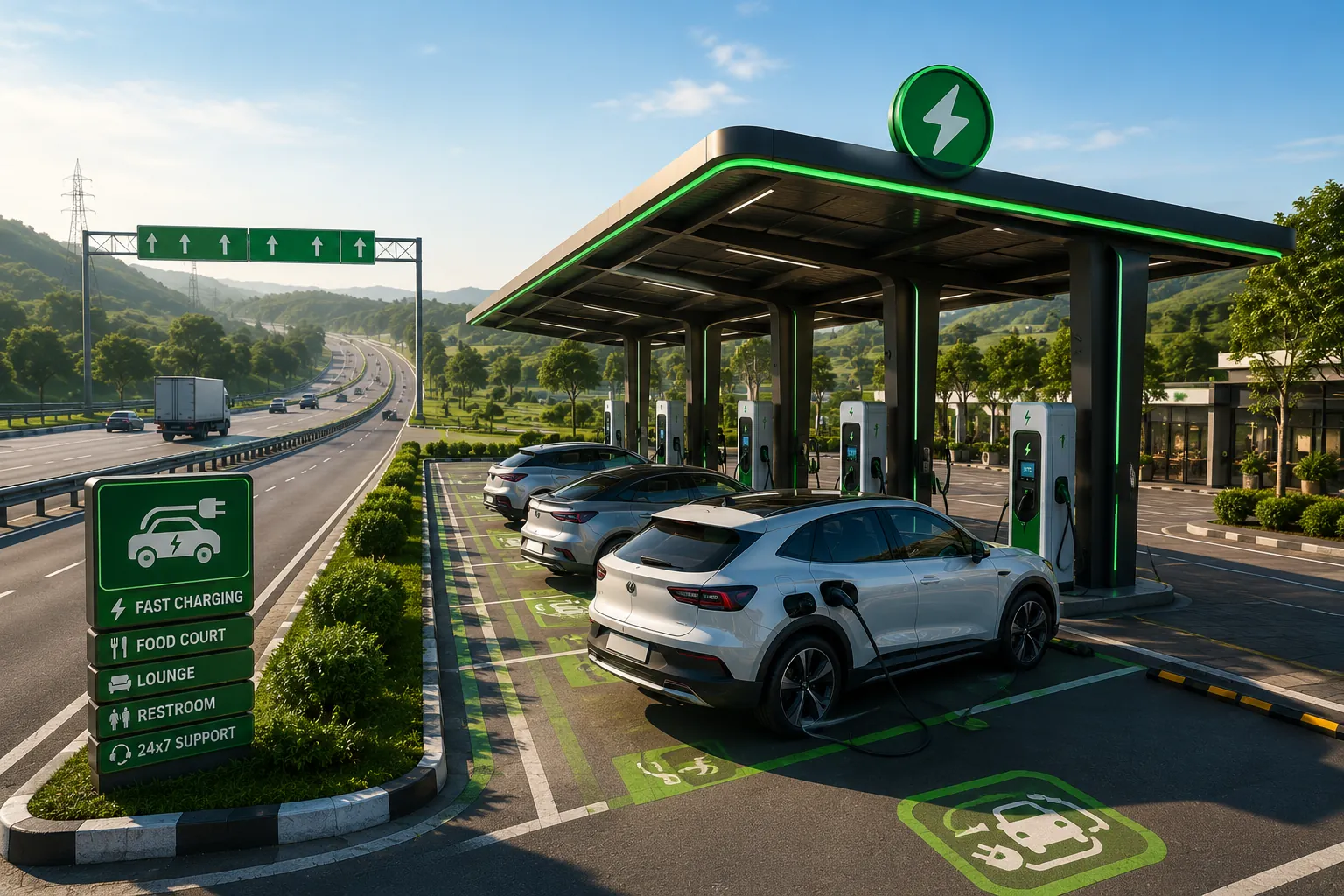
There is an important difference between installing a charging station and developing a charging hub. A standalone charger offers a place to replenish a vehicle's battery. An integrated hub, on the other hand, can accommodate multiple vehicles, provide different charging speeds and offer convenient facilities for travelers.
This distinction is becoming increasingly relevant as highway traffic and EV adoption evolve. Modern EV Charging Hubs on Highways are being developed around a more comprehensive experience, potentially incorporating:
- Multiple fast-charging dispensers.
- Dedicated parking and accessible entry points.
- Food and refreshment facilities.
- Restrooms and comfortable waiting areas.
- Digital payment and charging management systems.
- Battery monitoring and real-time station information.
For travellers, this creates an opportunity to combine charging with a natural rest stop.
Instead of treating battery replenishment as an interruption, highway operators can make it part of a planned travel break. Restaurants, retail outlets and wayside amenities can also benefit from increased visitor activity. This is where charging hubs move beyond infrastructure and become part of the wider highway experience.
Fast-Charging Technology Is Changing Long-Distance Travel
Time is one of the most important considerations when travelling long distances. While overnight charging works well for vehicles parked at home, highway journeys require a different approach. Fast-charging technology addresses this requirement by delivering higher power levels, allowing compatible electric vehicles to replenish their batteries more quickly.
The IEA classifies public charging points delivering more than 22 kW and up to 150 kW as fast chargers, while those rated at 150 kW or above fall into the ultra-fast category. According to its 2026 report, a vehicle capable of accepting the required charging power could gain almost 180 km of driving range from a 15-minute session at a 150 kW charger under mixed driving conditions. However, actual charging performance depends on the vehicle's battery architecture, charging capability, temperature, battery state of charge and the charger's available output.
This distinction matters. Installing a high-powered charger does not automatically mean every vehicle can use its maximum capacity. For highway infrastructure developers, the challenge is to deploy equipment that matches the needs of the vehicles using each corridor. As battery technology advances and compatible vehicle models become more accessible, high-power charging facilities are likely to become increasingly important for intercity mobility.
Major Highway Corridors Are Becoming Important EV Routes
India's extensive National Highway network offers significant opportunities for electric mobility. However, charging infrastructure needs to follow actual travel patterns rather than being distributed without considering demand. Recent highway-level data reported by Mint in January 2026, citing experiences with EVs, highlighted substantial growth in public fast-charging availability across several major routes during 2025.
Some notable examples include:
| Highway | Public fast-charging stations in 2025 |
|---|---|
| NH 48 | 652 |
| NH 44 | 574 |
| NH 66 | 240 |
| NH 16 | 227 |
| NH 65 | 213 |
NH 48, connecting Delhi and Chennai, recorded a 41% year-on-year increase, while NH 44, India's longest National Highway, witnessed 70% growth. NH 66, which runs from Panvel(Mumbai) towards Kanyakumari, also recorded a notable expansion. These figures demonstrate how charging availability is developing along important travel corridors. They also highlight the potential of routes connecting major commercial centres, industrial destinations and tourism locations.
For instance, southern India's highway network offers considerable opportunities for connecting cities such as Chennai, Bengaluru, Coimbatore and other important destinations. Nevertheless, the number of installed chargers is only one measure of progress. Their operational condition, accessibility, charging capacity and distribution along the route are equally important.
Private Investment Is Accelerating the Growth of EV Charging Infrastructure
Government initiatives provide an important foundation, but the expansion of highway charging infrastructure also depends on private participation. Energy companies, automobile manufacturers, charging point operators and infrastructure developers are investing in different parts of the ecosystem.
Fuel retail companies can integrate EV charging into existing outlets, while dedicated operators can establish larger facilities at strategic highway locations. Automotive brands can also collaborate with charging networks to improve customer access. The business opportunity extends beyond electricity sales. Charging hubs can generate additional value through retail partnerships, food services, advertising, fleet agreements and other traveller-focused offerings.
For operators, location selection becomes a crucial decision. Traffic density, grid connectivity, land availability, nearby amenities and expected charging demand all influence commercial viability. For investors, this presents a developing infrastructure segment with opportunities across installation, energy management, maintenance and customer services
Building Reliable Charging Networks, Not Just Adding More Chargers
A growing network is encouraging, but the real test lies in its everyday performance. A charging station that appears on a digital map but remains unavailable offers little value to a driver travelling hundreds of kilometers. Similarly, inadequate power supply, incompatible connectors, poor maintenance and long waiting times can affect the overall experience. India's charging ecosystem must therefore priorities operational reliability alongside expansion.
Some of the most important considerations include:
- Grid readiness: Charging hubs require adequate electricity connections and dependable power availability. High-capacity installations may also need dedicated electrical upgrades.
- Interoperability: Compatible connectors, payment systems and accessible charging networks make the experience simpler for different vehicle owners.
- Maintenance: Regular inspections, equipment servicing and timely fault resolution help keep facilities operational.
- Smart management: Digital monitoring can provide information about charger status, energy consumption, usage patterns and equipment performance.
- Renewable energy integration: Solar installations and other clean-energy solutions can complement grid electricity, subject to site conditions and energy requirements.
These factors determine whether highway charging becomes a dependable service or simply another infrastructure addition.
The Future of EV Charging Infrastructure on Indian Highways
The future of electric mobility will depend on how effectively vehicles, charging networks and energy systems develop together. The IEA's Global EV Outlook 2026 projects that India's public charging network could exceed 520,000 charging points by 2035 under its Current Policies Scenario. Achieving this projection would require approximately 43,000 additional public charging points annually on average between 2026 and 2035.
This is a projection, not a guaranteed outcome. Nevertheless, it highlights the scale of infrastructure development required to support the country's evolving electric vehicle market. Several developments could shape the next stage:
- High-power charging: Greater deployment of compatible fast and ultra-fast charging equipment.
- Smart charging networks: Better coordination between electricity supply, vehicle demand and station availability.
- Fleet electrification: More charging opportunities designed around commercial vehicles and high-utilisation transport.
- Renewable integration: Greater use of solar power and energy storage where commercially and technically viable.
- Connected highway experiences: Charging facilities integrated with digital travel platforms and roadside services.
The opportunity is not limited to making electric vehicles easier to charge. It is about creating a transport ecosystem that is efficient, accessible and ready for future mobility requirements.
Conclusion
The rise of Highway EV Charging Hubs represents an important shift in India's electric mobility journey. Growing EV adoption, government-backed infrastructure initiatives, faster charging technology and private-sector participation are collectively changing how long-distance electric travel is planned.
Yet, the real measure of progress will not be the number of chargers installed. It will be how reliably drivers can access them, how efficiently facilities operate and how seamlessly different routes connect. As India moves towards a more electrified transportation landscape, Electric Vehicle Highway Infrastructure will become an essential part of making sustainable travel practical beyond city boundaries. The road ahead is not just about electric vehicles. It is about building the infrastructure that keeps them moving.
Ready to Power the Next Mile?
The future of electric mobility is being built one charging connection at a time. At Relux Electric, we believe dependable charging infrastructure is central to making electric journeys more accessible and convenient. Explore how Relux Electric can support your EV charging infrastructure requirements and take a step towards powering India's evolving electric mobility landscape.
Relux Electric – Powering Progress. Driving the Future.
Your EV Charging Business Deserves a Partner Who Shows Up Every Single Day
At Relux Electric, we build reliable, high-uptime charging hubs with turnkey execution, smart CMS software, and full operational support across India.
Start Your Franchise Today